How to Launch a Local Postcard Marketing Business (Step-by-Step Guide)
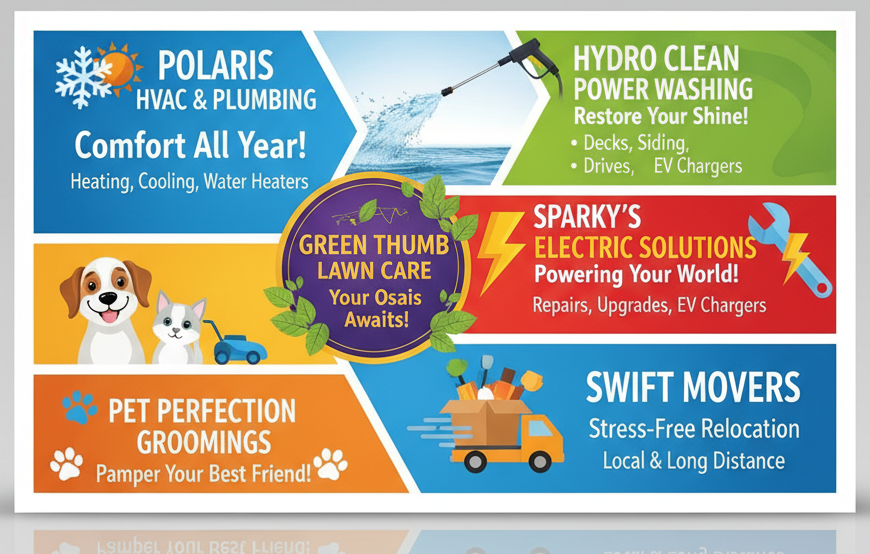
Example of a glossy postcard mailer. By consolidating several local ads on one postcard, businesses share the cost of reaching thousands of homes via direct mail.
What Is the Postcard “Co-Op” Marketing Model?
This model involves mailing a large postcard (often 9×12 inches) filled with several businesses’ ads to all homes in a chosen area. Instead of one business bearing the full mailing cost, 10–12 advertisers split the cost, making it far cheaper per business. For example, if 10 businesses each pay about $450, you could mail 10,000 postcards – something that would normally cost one business around $3,500 on their own. Every advertiser gets “huge exposure, for a fraction of the cost”, and you as the organizer profit by charging more than the total mailing expenses. It’s a win-win: businesses reach local customers cheaply, and you earn income for coordinating the campaign. The idea is simple: design an eye-catching oversized postcard with multiple ads and mail it to thousands of households. The large 9×12 format is popular because it provides plenty of space for ads and is hard to ignore in the mailbox. Unlike coupon envelopes or booklets, a single big postcard is “zero friction” – recipients see all the offers at a glance with no pages to flip. This guide will walk you through launching this postcard marketing business step by step, with no fluff – just practical how-to.
Step 1: Plan Your Postcard Campaign
Choose Your Target Area and Mailing Size: Start by deciding where and how many homes you’ll mail to. Many postcard entrepreneurs find that a 5,000-household mailing is a “sweet spot” – it’s large enough to impress, but still affordable for small businesses to join. (Some aim for 10,000, but 5,000 is often sufficient and lets you price ad spots accessibl.) Use the USPS Every Door Direct Mail (EDDM) online tool to map out carrier routes in your area and get an address count. EDDM is a USPS program that lets you send marketing mail to every address on chosen routes without needing a mailing list. You can send up to 5,000 mail pieces per day per ZIP code** via EDDM Retail service. Simply pick the neighborhoods that make sense for your advertisers (e.g. local communities near the businesses).
Pick the Postcard Size: Your postcard must meet USPS “flat” mail requirements. 9×12 inches is the gold standard for co-op mailers – it’s big enough to fit many ads and “immediately stand out in a sea of smaller mailers”. (USPS requires an EDDM piece to be larger than normal letters – a 9×12 card easily qualifies.) Ensure the design leaves the required blank areas for addressing and indicia. For example, reserve a 2″×4″ space for the EDDM indicia and postal customer address block. Also use sturdy cardstock that meets thickness rules (at least ~0.007″ thick) so the postcards are durable and USPS-compliant. The big postcard has a major benefit: it’s like a “billboard in the mailbox” – impossible to miss. This oversized format gives you room for bold headlines and multiple offers, and it won’t get buried under other mail.
Estimate Costs: Plan out your costs per mailing. EDDM postage is roughly $0.20 per piece. Printing a 9×12 postcard in volume might cost another ~$0.10–$0.20 each (shop around with trade printers or online postcard specialists). For instance, one small business reported 5,000 postcards cost about $1,600 total (printing + postage) to mail via EDDM – that’s $0.32 each. By having advertisers share the card, you reduce the cost per business dramatically. (In fact, the co-op model “brings down the cost to pennies per home, less than the cost of a stamp” by spreading it among multiple advertisers.) Knowing your costs will help you set a profitable price for each ad spot.
Legitimize Your Operation: Even if starting as a side hustle, treat it like a real business. Register a DBA or LLC (to separate finances and sound professional), open a dedicated bank account, and use an easy payment system (many use Square or PayPal to invoice advertisers). This keeps your bookkeeping clean. Also, plan how you’ll name the venture when pitching (e.g. “Local Mail Marketing” or something credible). A little prep upfront adds credibility when recruiting businesses and prevents headaches later.
Step 2: Sell Ad Spots to Local Businesses
This is the hustle part – you need to sign up enough businesses to fill the postcard. A 9×12 card can typically fit anywhere from 8 up to 16 ads (e.g. 12 ads is common, each roughly business-card size or a bit larger on the front and back). Determine your ad layout and how many spots you’ll sell, then do the math on what each spot should cost. Many find that charging around $300–$500 per ad for a 5,000-household mailing works well – for example, $500 per slot is often used as it’s a round number and seen as a “sweet spot” price that many small businesses find affordable. At $500 × 10 advertisers = $5,000 revenue (or $6,000 if 12 advertisers at $500 each). After ~$1.6k in mailing costs, you’d clear roughly $3,400–$4,400 in profit for one mailing. Even lower prices can work (e.g. $300–$400) if your area’s businesses are very price-sensitive – you’d just include more advertisers or mail slightly fewer homes to keep it profitable. Make it an attractive deal: Emphasize what each business gets for the price (their own ad reaching thousands of local homes). Compare it to what it’d cost them to mail solo. For instance, “Typically, reaching 10,000 homes might cost you $3k+, but on our shared mailer you can do it for only $450.” This value proposition is your main selling point.
Find Likely Advertisers: Focus on local businesses that already spend on advertising, because “you’re working with people who value what you’re offering”. Good targets are restaurants, home services (plumbers, HVAC, landscapers), realtors, auto services, health/beauty spas, etc. Look at who advertises in local magazines, ValPak/Money Mailer coupons, community bulletins, Facebook local groups, etc. Those businesses already budget for marketing and will understand the concept quickly. You can approach them by phone, email, or in person with a short pitch. For example: “Hi, I’m organizing a local co-op postcard that will be mailed to every home in [Area]. We have [number] ad spots for non-competing businesses. It’s an exclusive opportunity – only one business per category – and it’ll get you seen by 5,000 households for just $X. Would you be interested?” Note the exclusivity – small businesses love hearing they’ll be the only plumber, the only pizzeria, etc., on the card. Also highlight that this is “guaranteed delivery” to all homes in their target neighborhoods (unlike digital ads that may or may not reach locals) and that direct mail has high visibility. You can cite that oversized postcards tend to be kept and noticed – often stuck on the fridge or kept on the counter, especially if they carry useful coupons. This is tangible advertising with “no competition, no clutter” around their ad.
Overcome Skepticism: Some business owners might recall junk mail packs that get trashed. Explain why your postcard is different. It’s not a fat envelope of 50 ads like ValPak (which many people discard unopened); it’s a single, glossy jumbo postcard that “everyone can see at a glance”, so their offer won’t be overlooked. There’s no envelope to open and no other competitor in their category on the card, eliminating noise. Essentially, their ad will be front-and-center in every mailbox, impossible to ignore, and at a fraction of the cost of doing it alone. For many small businesses, spending a few hundred dollars to hit thousands of local homes is a no-brainer – “for less than $500 it can’t hurt to try”, as one Reddit user noted.
Pitch Tactics: You can cold call or walk in to businesses, but don’t overlook email and social media. Some co-op mailers send out brief emails (personalized, not spammy) to local businesses – even aiming for 50 emails a day – and get leads that way. Networking in community Facebook groups or Chambers of Commerce can also find interested advertisers. When you get a “maybe,” be ready to follow up persistently (many will go silent and need a reminder). Once a business says yes, collect their payment (at least a deposit) and their ad content. Important: Always be clear about timelines and expectations – tell them when you plan to print and mail, how many homes, what area, and any design help you’ll provide. Providing a simple one-page agreement or email confirmation that outlines the ad size, cost, mail date, and that you’ll give them a proof to approve can prevent misunderstandings. (Always get advertisers’ approval on the final ad proof in writing before printing – “double-check everything and always get approval… A little prep work upfront saves a ton of headaches later”.)
Step 3: Design and Prepare the Postcard (No Graphic Skills Needed)
Gather Ad Materials: As you sign up businesses, gather what each wants on their ad. Some may give you a ready-made design or logo and text. Others might just say “Please create something for my 15% off coupon.” Get their logos, any images they want, the offer text, contact info, etc. You don’t need to be a professional designer to assemble a decent-looking postcard these days. Use templates and simple tools to your advantage. For instance, there are Canva templates specifically for 9×12 co-op postcards – you can literally drag-and-drop the businesses’ info into pre-made ad blocks. Canva is very user-friendly and was noted as a great option for those with “limited design experience”. Each ad spot should be clean and readable. If you’re not comfortable designing, you can hire a freelance designer or use template marketplaces (even Etsy sells 9×12 postcard layout templates). But many organizers do it themselves with Canva or similar tools.
Design Tips for High Response: A cluttered postcard helps no one. Aim for a bold, simple layout for each ad: Clear headline or offer, an eye-catching image, and a call-to-action. For example, a restaurant ad might show a delicious entrée photo with “$5 Off Your Order” in big text, and “Visit our website or call to order – use code POSTCARD5” as the call-to-action. Make sure each ad’s key offer jumps out. Use bright colors and large text for discounts (“50% OFF”, “FREE X with Purchase”, etc.). Including a limited-time element (“Expires Dec 31”) can spur action. Also, ensure every ad includes contact info (phone, address, or website) and perhaps a tracking code or coupon so the business can notice the responses. Many successful mailers now add QR codes for each ad – let’s say a gym has a QR code that leads to a free trial signup page – because it “allows recipients to easily access more info” and also tracks engagement. It’s not required, but it’s a modern touch that some businesses appreciate.
When designing the postcard as a whole, maintain consistency: use the same font for all business names or offers for a clean look, and fit the ads together like a puzzle. Typically, you’ll arrange a grid on both front and back of the card. Leave a 2-inch high area on the back for the postal indicia and addressing (usually top right corner for the EDDM indicia “Local Postal Customer” etc., and top left for a return address or just a design element). Many co-op postcards also feature a banner or title like “Local Deals Card” or “[Town Name] Super Savings Mailer” – this can go in a spare spot or along an edge as branding. Not necessary, but it can make the piece feel like a unified community mailer rather than random ads. Keep any such title small compared to the ads; the businesses’ ads are the star. Overall, less is more: “Avoid overcomplicating the layout… focus on core value propositions and make it easy for recipients to take action.” Each ad should be digestible in 2 seconds of a glance.
Quality Check: Before printing, double-check every ad: correct phone numbers, addresses, coupon codes, expiration dates, etc. Send each business a final proof of their ad block (or the whole postcard proof) and get a written “OK” from them. This avoids any “you printed the wrong price!” issues later. Print a test page on your home printer if possible to see that text is legible. A 9×12 is large, so typically fonts below ~10pt might still be readable, but try to keep important text bold and not tiny. High-resolution images are important – ensure any photos/logos you use aren’t blurry. (Tip: Many printers require 300 DPI artwork for sharp print; using Canva or a professional template will usually handle resolution for you.) Finally, make sure the postcard front/back are set up according to the printer’s specs (bleed margins, etc., which they often provide templates for). Once everything is good, you’re ready to print!
Example layout of a 9×12″ co-op postcard (template preview). Each business gets its own ad section with a bold offer, imagery, and contact info. Such designs are highly “fridge-worthy” – glossy, colorful, and designed to be kept visible.
Step 4: Print and Mail the Postcards via USPS EDDM
Printing: Use a printing service that is familiar with EDDM requirements. Plenty of online printers (Vistaprint, GotPrint, PrintPlace, etc.) can print EDDM-compliant postcards and some even offer bundling for EDDM. For a 9×12 card, you’ll likely want 14pt or 16pt card stock with glossy UV coating for a professional look (and durability). Order enough quantity to cover your routes (always get a few extras for yourself and your advertisers). For example, if you plan to mail 5,000, you might print 5,100 so you have spares. Ensure the printer knows it’s for EDDM – they’ll usually leave the postage indicia area blank (or some will pre-print the EDDM indicia if you included it in your design). Typical cost: Many report ~$500–$800 to print 5,000 large cards in bulk (prices vary). Shop around or use trade printers for better rates. If timing is critical, use a local print shop or pay for faster shipping from an online printer.
Preparing for Mailing: Once you have the printed postcards in hand, you must prepare them in bundles with USPS facing slips (one for each postal route). The USPS EDDM tool will have given you a count for each route (e.g. Route 1: 742 addresses, Route 2: 855 addresses, etc.). By USPS rule, you must make bundles of 50 or 100 pieces (100 is most common for flats) for each route. For example, if a route has 742 addresses, you’d prepare 7 bundles of 100 and 1 bundle of 42, each with a paper “facing slip” on top labeled with that route’s details. (The EDDM tool lets you print these facing slips pre-filled with route info when you submit the mailing online, or you can fill out Form PS3587 by hand.) Rubber band each bundle tightly. The facing slip (half-sheet paper) on top of each bundle should show: Retail Indicia (EDDM Retail), the Route number, number of pieces in that bundle, and your permit info or “Post Office of Entry” – the USPS user guide and the EDDM website explain this, but it’s basically checking some boxes and writing numbers. It’s straightforward once you see the form. Make sure all bundles for a route have the correct count and route labels, as “the Post Office won’t accept your mailing if bundling is done wrong”. Also, segregate bundles by route (each route in its own tray or stack).
Paperwork and Drop-off: Log in to your USPS EDDM account and create the mailing if you haven’t already. You’ll select the routes and dates, and it will generate an EDDM Retail mailing statement (PS form 3587) for you. Pay for the postage online or choose to pay at the post office. For EDDM Retail, you’ll pay at the retail counter (if online payment isn’t completed). Postage is currently around $0.19–$0.20 per piece for EDDM Retail USPS Marketing Mail® flats. So 5,000 pieces costs about $950 in postage. Once everything is bundled and paperwork ready, take the cards to the Destination Post Office for those routes. (The EDDM tool will specify the drop-off location – often the main post office of that area or individual post offices for each ZIP). Bring the bundles in USPS-approved trays or boxes with the paperwork. At the post office, hand them the bundles and forms, pay any postage due (or show that you paid online with receipt), and that’s it – USPS will deliver them to every address on the chosen routes. You’ve now got an EDDM campaign in motion! Pro tip: Be friendly with the postal clerks – EDDM is a routine service for them, but if it’s your first time, don’t hesitate to ask if everything looks in order. They’ll check the bundle counts and forms. After drop-off, save your paperwork receipt – and mark the date on your calendar when the postcards will hit mailboxes (usually within 1-2 days of drop-off for local).
Step 5: Profit, Track Results, and Repeat
Once mailed, notify your advertisers that the cards are hitting mailboxes (they might get calls or coupon redemptions soon). It’s good practice to deliver or mail each business a couple of sample copies of the postcard for their own use – it shows them exactly how it turned out, and they can see all the other ads too. Now you can tally up your earnings from that card. Pay any remaining vendor bills (printer, etc.), and the rest is profit. Congrats – you just executed a co-op postcard mailing!
Gather feedback and results: Check in with your advertisers after a few weeks. Did they see an uptick in inquiries or sales? How many coupons came in? This not only proves the value of your service but also sets you up for repeat business. If some advertisers got great results, they’ll likely sign on for the next mailing. If a few saw weak results, discuss what could improve – maybe a stronger offer or mailing to a different neighborhood next time. Direct mail response rates can vary widely based on the business type and offer. (For instance, a pizza shop coupon might pull a higher response than a high-ticket service with no discount.) Educate businesses that repetition improves ROI – marketing lore says “once is not enough”. One mailing is great, but mailing to the same homes multiple times can boost recognition and trust, leading to better overall response. If possible, get commitments for a series (like a restaurant might do 3 mailings in a row). But even if you run each mailing as a one-off project, try to retain advertisers for future cards by delivering value.
Plan your next mailing: With one success under your belt, you can rinse and repeat. You might choose a new area for the next postcard or run the same area again with new offers. Many postcard entrepreneurs aim for monthly mailings in each target area (since consistency yields best results). How often you mail is up to you, but ensure you leave enough time to sell the spots and produce the card. As you grow, you could even juggle multiple postcards in different areas simultaneously – effectively running a few campaigns per month. Some have scaled this into a full-time business: for example, selling out one card, then two, then three cards per month and soon you’re generating a solid income. With, say, $3k profit per card, doing three a month could gross ~$9k. Indeed, with focus and hustle, a six-figure annual business is attainable in this model. The overhead stays low (mostly printing and your time), and you can expand by covering neighboring towns or new niches.
Scale smartly: As money comes in, consider reinvesting into efficiency. You can outsource tasks that eat your time – e.g. hiring a graphic designer to handle ad design while you concentrate on sales. Or use a fulfillment service for printing/mailing if the volume gets too high; some companies will take your design and handle the EDDM paperwork and delivery for a fee. But many keep doing it themselves to maximize profit. Another avenue: offer your advertisers add-on services. You’ve built a relationship by helping with the postcard; you could upsell things like printing them business flyers, managing a digital ad campaign, designing their logo, etc. Some postcard marketers turn into full-service local marketing agents over time, increasing each client’s lifetime value.
Lastly, maintain professionalism and integrity. Deliver what you promise – on time mailings, the agreed home reach, and good print quality. If an error happens (e.g. a typo slipped through), own it and make it right with the business (maybe a discount on next mailing). Your reputation in the local business community will make or break this venture. Do a great job and you’ll get referrals – other businesses will hear “that mailer brought me new customers” and will want to join next time.
Final Thoughts
Running a co-op postcard mailing business is a straightforward but rewarding hustle. You help local businesses get tangible results by putting their offers directly into local homes, and you earn a healthy profit for making it happen. The startup cost is low (essentially just printing and postage for the first card, covered by advertisers’ fees), and you don’t need prior experience in marketing – this system has “minimal barriers to entry”. Success comes from taking action and learning as you go. If you’re proactive in reaching out to businesses and consistent in execution, you can quickly build a recurring income stream. Remember to think long-term: each postcard mailing is not just an ad, but a door-opener to ongoing relationships. By establishing yourself as a local marketing connector, you might grow beyond just postcards into a thriving business of your own. Now, with these steps in hand, it’s time to start turning those conversations into cash – design that postcard and dive in!